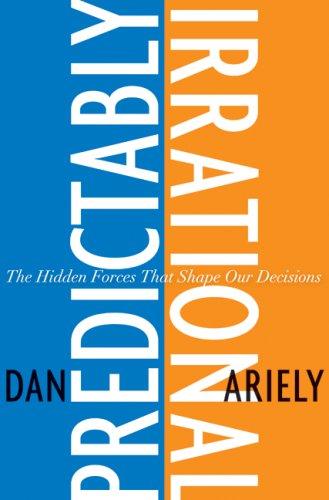
Book summary
Predictably Irrational by Dan Ariely explores the hidden psychological forces and cognitive biases that systematically distort human decision-making, showing that people are not rational actors as assumed by traditional economics but instead behave in predictably irrational ways. Through clever experiments and everyday examples, Ariely demonstrates how factors like expectations, emotions, social norms, relativity, free offers, and anchoring skew our choices in areas ranging from pricing and saving to relationships and ethics. The core argument is that these irrationalities are not random errors but consistent patterns that can be understood and sometimes mitigated, and that relying on standard economic theory for personal, business, or policy decisions can lead to trouble, as evidenced by the 2008 financial crisis. The revised edition expands on these insights with new studies and reader responses to advocate for better awareness in designing systems that account for real human behavior.
Key founder lessons
-
1
Relativity drives pricing power
Founders should create high-priced decoys to make flagship products appear cheaper by comparison, as Ariely's experiments show decisions are relative not absolute.
-
2
Free distorts value perception
Avoid offering free tiers that cannibalize paid ones; Ariely demonstrates how zero price inflates demand irrationally, skewing customer choices in product strategy.
-
3
Anchoring sets reference points
Set high initial prices or expectations early because first numbers anchor all future negotiations and perceived value, per Ariely's price-priming studies.
-
4
Ownership inflates valuation
Leverage the endowment effect by letting users customize or invest time in products, causing them to overvalue what they own as shown in Ariely's mug experiments.
-
5
Social norms beat market norms
Build community and reciprocity instead of pure transactions; Ariely's research reveals social norms create stronger loyalty and effort than cash incentives.
Similar books
-

Thinking, fast and slow
Daniel Kahneman
Reveals cognitive biases that shape decisions, helping founders avoid irrational choices in business.
-

Nudge
Richard H. Thaler, Cass R. Sunstein
Shows how to design choices that improve outcomes, vital for product design and customer behavior.
-

Misbehaving
Richard H. Thaler
Explains behavioral economics in real-world contexts, offering practical insights for startup strategy.
-

The undoing project
Michael Lewis, Dennis Boutsikaris
Chronicles Kahneman and Tversky's work on biases, teaching better judgment for leadership and hiring.
-
Influence
Robert B. Cialdini
Details persuasion principles that drive sales, marketing, and negotiation in startups.
-
Fooled by randomness
Nassim Nicholas Taleb
Exposes how randomness and bias affect success, guiding smarter risk-taking in business.
Founder activity
Nobody has shelved this yet
Be the first founder to add it.